
Sherman and His Generals
1860s
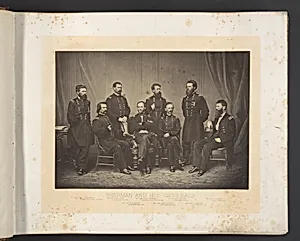
Medium
Albumen silver print from glass negative
Classification
Photographs
Department
Photographs
Museum
Metropolitan Museum of Art, New York, NY
Credit
Pfeiffer and Rogers Funds, 1970
Accession Number
1970.525 (1)
Rights
Public Domain
Tags
Art Historical Context
George N. Barnard's "Sherman and His Generals," created in the 1860s, offers a compelling glimpse into the leadership of the Union Army during the American Civil War. This albumen silver print captures General William Tecumseh Sherman alongside his key officers, presenting them in a formal group arrangement that underscores their collective resolve. As one of the era's pioneering war photographers, Barnard documented Sherman's campaigns with a documentary eye, helping to shape public understanding of the conflict through visual records rather than paintings alone. The choice of albumen silver print from a glass negative was significant for its time, as it allowed for sharp detail and the production of multiple high-quality copies. This medium enabled Barnard's images to circulate widely, serving both as historical evidence and as tools for remembrance. The photograph's straightforward composition emphasizes the generals' authority and camaraderie, reflecting the era's growing trust in photography to convey truth. Today, this work stands as an important artifact in the Metropolitan Museum of Art's collection, illustrating how early photography bridged art and history. It invites viewers to consider the human stories behind military strategy and the role of images in preserving national memory.
About the Artist
George N. Barnard · 1819–present
George N. Barnard (1819–1902) was a pioneering American photographer whose six-decade career spanned the dawn of the medium, from daguerreotypes to Civil War documentation. Born into a farming family in Coventry, Connecticut, on December 23, 1819, he lost his father at age seven and apprenticed in family businesses before marrying in 1843 and relocating to Oswego, New York. There, he launched one ...