
Shilling
ca. 1667–ca. 1682
Medium
Silver
Dimensions
1 3/16 in., 4.68 Grams (3 cm, 3.009 dwt)
Classification
Coin
Culture
American
Department
The American Wing
Museum
Metropolitan Museum of Art, New York, NY
Credit
Bequest of Alphonso T. Clearwater, 1933
Accession Number
33.120.377
Rights
Public Domain
Tags
Art Historical Context
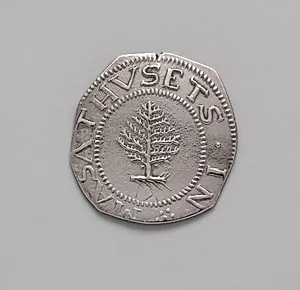
Behold the humble yet revolutionary *Shilling*, a silver coin struck by pioneering American silversmiths John Hull Robert Sanderson Sr. around 1667–1682. Minted in Boston during the early colonial era, this petite treasure—measuring just 1 3/16 inches across and weighing a mere 4.68 grams—resides in The Met's American Wing, a bequest from Alphonso T.water in 1933. As one of the first coins produced in the English colonies, it embodies the scrappy ingenuity of New England settlers. In an act of bold defiance against British monetary restrictions, the Massachusetts Bay Colony authorized Hull and Sanderson to establish the continent's first mint in 1652. Their "Pine Tree Shillings" featured a stylized pine tree on the obverse, symbolizing the region's vast forests and natural wealth, paired with "NEW ENGLAND AN DOM" inscriptions. Crafted from hammered silver, often sourced from Spanish coin clippings, these pieces marked America's earliest bid for economic independence, circulating widely despite royal ire—they were later demonetized in 1684. This artifact whispers of colonial ambition: trees for prosperity, money for self-reliance. A tangible link to the birth of American commerce, it invites us to ponder how such small silver discs fueled dreams of a new world.