
Shining Metal
1858
Medium
Photography-Photoprint
Classification
Photography-Photoprint
Department
Smithsonian Collection
Museum
Smithsonian American Art Museum
Credit
Smithsonian American Art Museum, Museum purchase from the Charles Isaacs Collection made possible in part by the Luisita L. and Franz H. Denghausen Endowment
Accession Number
1994.91.270
Rights
Public Domain
Tags
Art Historical Context
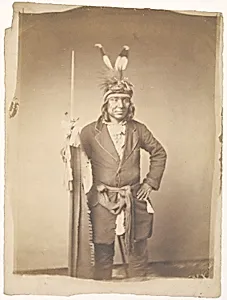
**Shining Metal** (1858) is a striking photographic portrait by Julian Vannerson a pioneering 19th-century American photographer known for his documentation of Native American leaders. Captured as a photop—a early process using albumen paper to produce detailed, richly toned images from glass negatives—this work preserves the dignified presence of a Mdewakanton Dakota chief The subject appears in traditional Indian dress, his attire and bearing reflecting the cultural pride of the Mdewakanton band of the Dakota (Sioux) people from the upper Midwest. Created amid rising tensions between Native nations and expanding U.S. settlements, the portrait holds profound historical significance. Photography in the 1850s was a novel medium, often used to record indigenous leaders during treaty negotiations or delegations to Washington, D.C. Vannerson's precise composition highlights the chief's regalia, offering a window into Mdewakanton identity and resilience just before pivotal events like the U.S.-Dakota War of 1862. Today, housed in the Smithsonian American Art Museum, *Shining Metal* exemplifies how early photography bridged art and ethnography, immortalizing a leader whose name evokes gleaming strength. It's a poignant reminder of Native sovereignty and the power of the camera to capture vanishing traditions.