
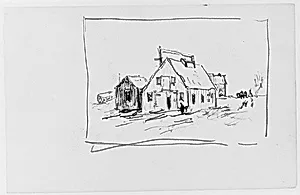
Shipyard in Connecticut (from Sketchbook)
Medium
Graphite, ink, on paper
Dimensions
Sheet: 4 7/8 x 7 7/8 in. (12.4 x 20 cm)
Classification
Drawing
Culture
American
Department
The American Wing
Museum
Metropolitan Museum of Art, New York, NY
Credit
Gift of Frederick K. Detwiller, 1930
Accession Number
30.138.12 recto
Rights
Public Domain
Tags
Art Historical Context
Nestled within the pages of Henry Ward Ranger's sketchbook *Shipyard in Connecticut* a fleeting glimpse of American industrial life. Ranger (1858–1916), a prominent American artist associated with the Tonalist movement, was for his atmospheric landscapes that emphasized mood over detail. This intimate drawing, executed in graphite and ink on a modest of paper measuring just 4 7/8 x 7 7/8 inches, likely served as a preparatory study during his travels along the Northeast coast. The scene depicts a bustling shipyard dotted with houses, evoking Connecticut's rich maritime heritage in the late 19th or early 20th century. Shipbuilding was a cornerstone of the region's economy, powering trade and naval ambitions. Ranger's use of graphite for subtle shading and ink for crisp lines highlights his skill in rapid, on-site sketching—a technique that allowed artists to distill complex scenes into essential forms, bridging studio painting and plein-air observation. Housed in The American Wing of the Metropolitan Museum of Art since its gift by Frederick K. Detwiller in 1930, this work offers visitors a window into everyday American scenes amid rapid industrialization. It reminds us how sketchbooks preserve the artist's hand and historical snapshots, revealing the quiet poetry in utilitarian spaces.
About the Artist
Henry Ward Ranger · 1858–1916
Henry Ward Ranger was born in 1858 in Syracuse, New York, and grew up to become one of the leading American landscape painters of the late nineteenth and early twentieth centuries. He received his early training in the United States before traveling extensively in Europe, where he spent significant time studying in Holland and England. The Dutch Barbizon painters — particularly the Hague School ar...