
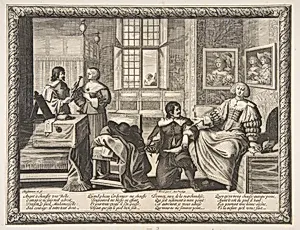
Shoemaker (Le Cordonnier)
ca. 1632–33
Medium
Etching; second state of two (Join-Lambert and Préaud)
Dimensions
sheet: 9 15/16 x 12 7/8 in. (25.3 x 32.7 cm)
Classification
Prints
Department
Drawings and Prints
Museum
Metropolitan Museum of Art, New York, NY
Credit
The Elisha Whittelsey Collection, The Elisha Whittelsey Fund, 1951
Accession Number
51.501.2249
Rights
Public Domain
Tags
Art Historical Context
**Shoemaker (Leonnier)**, created around 1632–33 by French printmakers Abraham Bosse and Jean Iblond, offers a vivid glimpse into 17th-century Parisian daily life. This etching, in its second state of two as noted by scholars Join-Lambert andaud, captures a bustling shoemaker's workshop. Men and women fill the intimate interior, surrounded by tools, leather, and half-finished shoes—a snapshot of a common trade that sustained urban communities during the reign of Louis XIII. Abraham Bosse, a master etcher renowned for his meticulous technique and interest in everyday scenes, likely handled the intricate line work, while Leblond may have contributed to the design. Etching allowed for the fine details that bring textures like worn floors and draped fabrics to life, making prints like this accessible reproductions of genre subjects. At 9 15/16 x 12 7/8 inches, it's a compact yet richly detailed piece from the Baroque era's growing fascination with ordinary labor. Housed in the Metropolitan Museum of Art's Drawings and Prints department through The Elisha Whittelsey Collection, this work highlights printmaking's role in democratizing art. It invites us to ponder the skilled hands behind our footwear, bridging art and craft in a pre-industrial world.
About the Artist
Abraham Bosse|Jean I Leblond · 1602–1676
Abraham Bosse (1604–1676) was a French printmaker and theorist whose approximately 1,600 etchings provide an unparalleled visual record of 17th-century French life. Born to Huguenot parents in Tours, he trained in Paris under Melchior Tavernier and became a devoted follower of Jacques Callot's technical innovations. Bosse's meticulous etchings depicted subjects ranging from daily life and fashion ...