
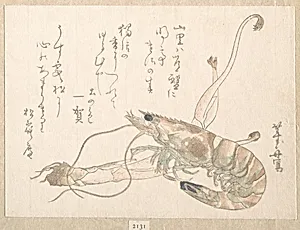
Shrimp and Udo Plant
Medium
Woodblock print (surimono); ink and color on paper
Dimensions
5 1/8 x 7 in. (13 x 17.8 cm)
Classification
Prints
Culture & Period
Japan · Edo period (1615–1868)
Department
Asian Art
Museum
Metropolitan Museum of Art, New York, NY
Credit
H. O. Havemeyer Collection, Bequest of Mrs. H. O. Havemeyer, 1929
Accession Number
JP2131
Rights
Public Domain
Tags
Art Historical Context
This delicate woodblock print, created by Uematsu Tōshū during Japan’s Edo period, captures a simple yet evocative still life of shrimp and an udo plant. Produced as a surimono—a privately commissioned print often exchanged among poetry circles—the work exemplifies the refined tastes of the era. Surimono were typically small in scale, like this example measuring just over five by seven inches, and were printed with exceptional care using premium papers and sometimes metallic pigments or embossing. In the context of Edo-period art, such prints bridged everyday subjects with literary traditions, frequently accompanying short verses. The shrimp, noted among the museum’s tags as lobster-like, and the udo—a seasonal Japanese vegetable—suggest themes of renewal and natural abundance, common in surimono designed for New Year greetings or seasonal celebrations. These intimate compositions invited quiet contemplation rather than public display. Housed in the Metropolitan Museum of Art’s Asian Art collection as part of the Havemeyer bequest, the print highlights the cross-cultural appreciation for Japanese graphic arts in the early twentieth century. Its modest size and meticulous technique continue to reward close viewing, revealing the subtle interplay of ink and color that defines this specialized print form.