
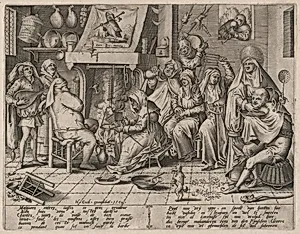
Shrove Tuesday
Medium
engraving on laid paper
Dimensions
plate: 22.3 × 28.8 cm (8 3/4 × 11 5/16 in.) sheet: 26.2 × 31.8 cm (10 5/16 × 12 1/2 in.)
Classification
Department
CG-E
Museum
National Gallery of Art, Washington, D.C.
Credit
Gift of Hope and Julian Edison
Accession Number
2019.114.7
Rights
Public Domain
Art Historical Context
Created in 1567 by Flemish engraver Pieter van der Heyden, *Shrove Tuesday* depicts the raucous pre-Lenten festivities of Carnival, a time of feasting and merrymaking before the austerity of. Rendered as an engraving on laid paper, the print measures just over 8 by 11 inches in the plate, its fine lines capturing the energy of communal celebration in 16th-century Northern Europe. Engraving was a vital medium during this period, enabling artists to reproduce intricate scenes that could reach broad audiences through affordable prints. Van der Heyden’s precise technique highlights the social customs and lively gatherings associated with Shrove Tuesday, preserving a vivid record of seasonal traditions for later generations. Now part of the National Gallery of Art’s collection through the generous gift of Hope and Julian Edison, the work invites viewers to reflect on how printmaking shaped the spread of cultural imagery across Renaissance Europe.