
The Witch of Malleghem
published 1559
Medium
engraving
Classification
Department
CG-E
Museum
National Gallery of Art, Washington, D.C.
Credit
Rosenwald Collection
Accession Number
1964.8.433
Rights
Public Domain
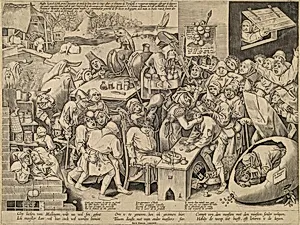
Art Historical Context
"The Witch of Malleghem," published in 1559, is an engraving designed by Pieter Bruegel the Elder and executed by Pieter van der Heyden. This Northern Renaissance work captures Bruegel’s signature style of dense, moralistic scenes filled with everyday figures caught in folly. The print uses intricate line work typical of engraving to create a lively, satirical tableau that invites close looking. Created during the Reformation era, when prints circulated widely as affordable commentary, the image critiques superstition and quackery through its crowded composition. Bruegel often drew on popular proverbs and folk traditions to expose human weakness, and this engraving extends that tradition to a broad audience beyond the elite circles of painting collectors. As part of the National Gallery of Art’s Rosenwald Collection, the work highlights the cultural importance of reproductive prints in 16th-century Europe. Van der Heyden’s skilled translation of Bruegel’s drawing into copperplate allowed the artist’s witty observations on society to reach viewers across regions and generations.