
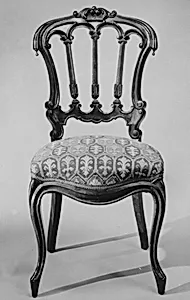
Side Chair
Unknown Artist
ca. 1855
Medium
Rosewood, ash
Dimensions
34 x 16 1/2 x 16 1/2 in. (86.4 x 41.9 x 41.9 cm)
Classification
Side Chair
Culture
American
Department
The American Wing
Museum
Metropolitan Museum of Art, New York, NY
Credit
Purchase, The Edgar J. Kaufmann Foundation Gift, 1968
Accession Number
68.202.2
Rights
Public Domain
Art Historical Context
This elegant side chair, crafted around 1855 by an unknown maker, exemplifies mid-19th-century furniture design in the United States. Standing at 34 inches tall with a compact 16½ x 16½-inch seat, it was designed for parlors or drawing rooms, where such chairs provided both comfort and refined decoration. The use of rosewood—a richly figured, imported hardwood prized for its durability and exotic sheen—paired with ash for structural elements, highlights the era's blend of local woods and luxury materials, reflecting growing American prosperity and trade networks. In the context of the antebellum period, this chair embodies the craftsmanship of urban cabinetmakers responding to fashionable tastes inspired by European revivals. Rosewood's prominence in furnishings of the 1850s underscores a shift toward ornate domestic interiors, where everyday objects like side chairs became statements of status and hospitality. Though the artist's identity remains unknown, the piece's presence in The Metropolitan Museum of Art's American Wing—acquired through the generous Edgar J. Kaufmann Foundation Gift in 1968—elevates it as a testament to anonymous artisans who shaped American material culture. Today, it invites us to appreciate the tactile artistry of furniture: the smooth contours, precise joinery, and patina of age that whisper stories of family gatherings and evolving home life. A subtle yet sophisticated survivor of its time.