
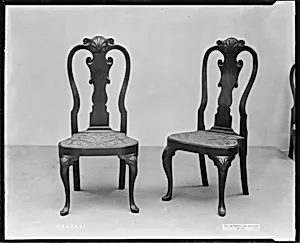
Side chair
Unknown Artist
1740–60
Medium
Walnut, yellow pine
Dimensions
42 3/4 x 20 x 19 3/4 in. (108.6 x 50.8 x 50.2 cm)
Classification
Side chair
Culture
American
Department
The American Wing
Museum
Metropolitan Museum of Art, New York, NY
Credit
Rogers Fund, 1925
Accession Number
25.115.6
Rights
Public Domain
Art Historical Context
This elegant side chair, crafted between 1740 and 1760 by an unknown American artisan, exemplifies the refined furniture making of the British American colonies during the mid-18th century. Made primarily from walnut—a dense, richly grained hardwood prized for its durability and warm mahogany-like patina—the chair features yellow pine for secondary structural elements, a practical choice reflecting colonial resourcefulness. Secondary woods like pine were often concealed beneath upholstery or moldings, allowing makers to balance quality with affordability. Measuring about 42 inches tall, it was designed for comfort in formal parlors or dining rooms, where such chairs flanked tables during genteel gatherings. Housed in The Metropolitan Museum of Art's American Wing and acquired through the Rogers Fund in 1925, this piece highlights the evolution of American decorative arts. During this era, colonial cabinetmakers drew inspiration from English styles like Queen Anne, evident in the chair's graceful proportions and subtle curves, though regional variations emerged due to local woods and tastes. Walnut's prevalence in the Northeast and Mid-Atlantic underscores timber trade networks that fueled early American industry. Step back in time as you imagine this chair hosting revolutionary-era conversations—its timeless form a testament to the skilled hands that furnished a new world.