
Side Chair
1791–1818
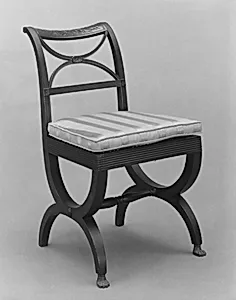
Medium
Mahogany, brass
Dimensions
32 3/4 x 17 3/4 x 16 1/4 in. (83.2 x 45.1 x 41.3 cm)
Classification
Side Chair
Culture
American
Department
The American Wing
Museum
Metropolitan Museum of Art, New York, NY
Credit
Gift of C. Ruxton Love Jr., 1960
Accession Number
60.4.11
Rights
Public Domain
Art Historical Context
This elegant side chair, crafted by renowned American cabinetmaker Duncan Phyfe between 1791 and 1818, exemplifies the refined furniture of the early Federal period. Made from rich mahogany—a premium tropical hardwood imported for its durability and warm grain—accented with brass details, the chair measures a compact 32¾ x 17¾ x 16¼ inches, ideal for intimate dining rooms or parlors in prosperous American homes. Phyfe, a Scottish immigrant who established a prominent workshop in New York City became synonymous with neoclassical design, blending clean lines, subtle carving, and classical motifs inspired by ancient Greece and Rome. Phyfe's work marked a golden age for American craftsmanship, as the young nation sought to rival European elegance post-Revolution. His pieces, like this side chair, catered to the rising merchant class, showcasing technical mastery in joinery and veneer techniques that ensured both beauty and longevity. Housed in The Metropolitan Museum of Art's American Wing since its 1960 gift by C. Ruxton Love Jr., it reflects the cultural aspiration of early 19th-century America: sophisticated, functional art that symbolized status and stability. Today, this chair invites us to imagine genteel gatherings in Federal-era mansions, a testament to Phyfe's enduring influence on American decorative arts.
About the Artist
Duncan Phyfe · 1770–1854
Duncan Phyfe (1770–1854) was a Scottish-born American cabinetmaker who became the most celebrated furniture maker in the history of American decorative arts. Born Duncan Fife near Loch Fannich in the Scottish Highlands, he emigrated with his family to Albany, New York, around 1783–84, where he apprenticed to a cabinetmaker. By 1792 he had established his own workshop on Partition Street (later Ful...