
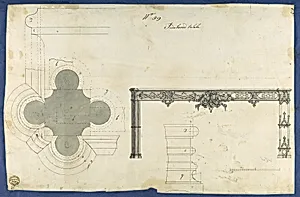
Sideboard Table, from Chippendale Drawings, Vol. II
Medium
Black ink, gray wash
Dimensions
sheet: 8 13/16 x 13 3/8 in. (22.4 x 34.1 cm)
Classification
Drawings|Ornament & Architecture
Department
Drawings and Prints
Museum
Metropolitan Museum of Art, New York, NY
Credit
Rogers Fund, 1920
Accession Number
20.40.2(41)
Rights
Public Domain
Tags
Art Historical Context
Step into the elegant world of 18th English design with Thomas Chippendale's *Sideboard Table*, a precise drawing from his *Chippendale Drawings,. II* (1753). Chippendale, one of Britain's most celebrated furniture makers, created this work during the Georgian era, just before publishing his groundbreaking pattern book, *The Gentleman and Cabinetaker's Director* (4). This sideboard table design exemplifies his innovative fusion of Rococo curves, Gothic elements, and exotic motifs, reflecting the era's taste for opulent, eclectic furnishings among the aristocracy. Rendered in black ink with subtle gray wash on a modest sheet (8 13/16 x 13 3/8 in.), the drawing showcases Chippendale's mastery of technical precision. Ink outlines the table's graceful proportions and ornate details—like cabriole legs and carved aprons—while the wash adds tonal depth, simulating wood grain and shadows for a lifelike rendering. Such techniques were essential for cabinetmakers, turning conceptual sketches into workshop blueprints. Housed in the Metropolitan Museum of Art's Drawings and Prints department (Rogers Fund, 1920), this piece offers a rare glimpse into the creative process behind Chippendale's global influence. Sideboards like this became status symbols in grand dining rooms, blending utility with artistry and shaping furniture design for generations. A testament to craftsmanship's evolution!
About the Artist
Thomas Chippendale · 1718–1779
Thomas Chippendale, baptized on June 5, 1718, in Otley, Yorkshire, was born into a family steeped in woodworking traditions, the only child of joiner John Chippendale and Mary Drake. His father likely provided his initial hands-on training in cabinetmaking, supplemented by time in the workshop of York joiner Richard Wood, before Chippendale relocated to London around 1749. He married Catherine Red...