
Siege Helmet
1610/20
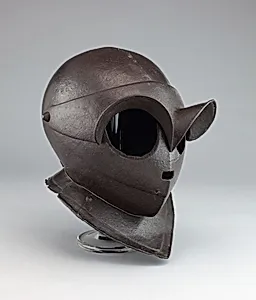
Medium
Steel
Dimensions
H.: 22.9 cm (9 in.)
Classification
suit-helmet
Department
Applied Arts of Europe
Museum
Art Institute of Chicago
Accession Number
112097
Rights
Public Domain
Art Historical Context
Step into the clangor of 17th-century battlefields with the *Siege Helmet*, a example of European arms and armor crafted around 1610–20. Forged from steel and standing just 9 inches (22.9 cm) tall, this compact yet formidable piece was designed as part of a suit armor, likely for an infantryman or officer enduring the brutal sieges of the era. Its modest height suggests it was a close-helmet variant, balancing mobility with protection during prolonged conflicts like the early phases of the Thirty Years' War. In the Applied Arts of Europe, such helmets highlight the pinnacle of metallurgical artistry before firearms largely supplanted plate armor. Master armorers employed skilled techniques—hammering, shaping, and possibly riveting steel plates—to create a form both functional and elegantly proportioned. The anonymous craftsmanship reflects the guild traditions of regions like the Holy Roman Empire or Italy, where armor evolved from medieval knights' gear into specialized gear for gunpowder-age warfare. This helmet at the Art Institute of Chicago invites us to ponder the human cost of Europe's turbulent age: a thin steel shell shielding lives amid cannon fire and starvation. Though utilitarian, its survival speaks to the enduring allure of objects that fused survival with superb design.
About the Artist
Unknown
The artist designated as "Unknown" in our virtual museum's collection exemplifies a poignant chapter in art history: creators whose identities have faded into obscurity despite the enduring power of their work. With only one known artwork attributed to them in our holdings, this figure represents countless anonymous hands that shaped visual culture across centuries. Museums worldwide, including th...