
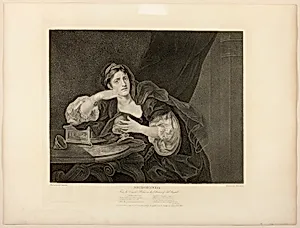
Sigismonda
published June 4, 1795
Medium
Engraving in black on tan wove paper
Dimensions
Image: 32.8 × 41.6 cm (12 15/16 × 16 7/16 in.); Plate: 40.7 × 44.6 cm (16 1/16 × 17 9/16 in.); Sheet: 47.4 × 62.9 cm (18 11/16 × 24 13/16 in.)
Classification
engraving
Department
Prints and Drawings
Museum
Art Institute of Chicago
Accession Number
160035
Rights
Public Domain
Art Historical Context
**Sigismonda** is a striking engraving by Benjamin Smith, a prominent British printmaker active in the late 18th century. on June 4, 1795, this work exemplifies the era's booming print culture, when engravings served as affordable reproductions of paintings, spreading artistic ideas across Europe. Housed in the Art Institute of Chicago's Prints Drawings Department, it measures an impressive image size of 328 × 41.6 cm on tan wove—a relatively new, smooth substrate that allowed for finer details compared to traditional laid paper. Smith's mastery of engraving shines through in the intricate black lines etched into copper plates, a labor-intensive technique that captured dramatic contrasts and textures. The title *Sigismonda* evokes a tragic heroine from medieval literature, likely Boccaccio's *Decameron*, symbolizing profound sorrow and passion—a popular neoclassical theme blending emotion with moral depth. Prints like this bridged elite art with wider audiences, fueling the Romantic sensibility just before the 19th century. Visitors will appreciate how this piece reflects engraving's role in democratizing art, preserving dramatic narratives on an intimate scale amid the Enlightenment's print revolution.