
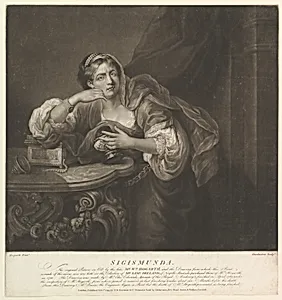
Sigismunda
February 1, 1793
Medium
Mezzotint; third state
Dimensions
Sheet (trimmed to plate line): 15 1/2 x 14 9/16 in. (39.4 x 37 cm)
Classification
Prints
Department
Drawings and Prints
Museum
Metropolitan Museum of Art, New York, NY
Credit
Harris Brisbane Dick Fund, 1932
Accession Number
32.35(148)
Rights
Public Domain
Tags
Art Historical Context
Welcome to the Metropolitan Museum of Art's Drawings and Prints department, where *Sigismunda (1793) captivates with its dramatic intensity. This mezzotint, in its third state, reproduces William Hogarth's poignant 1759 painting of the same title, inspired by Boccaccio's tragic tale from *The Decameron*. Depicting a mourning woman—likely Sigismunda—seated at a table with a chalice symbolizing profound grief, the work measures 15½ × 14⅝ inches (trimmed to the plate line Engraved by Robert Dunkarton and published by Tristam Bampfylde Freeman, it exemplifies 18th-century British artistry bridging painting and printmaking. Mezzotint, a "dark manner" technique invented in the 17th century, allowed Dunkarton to capture Hogarth's velvety tones and emotional depth, scraping highlights from a blackened plate for a luminous, painterly effect. Hogarth, a master of Rococo satire and moral commentary, crafted *Sigismunda* as a sublime study of passion and loss, though it sparked controversy among critics who deemed it overly sentimental. Acquired through the Harris Brisbane Dick Fund in 1932, this print highlights the era's fascination with literary tragedy and the mezzotint's role in democratizing high art. A testament to Hogarth's enduring influence, it invites visitors to ponder the raw power of human sorrow rendered in ink and copper.
About the Artist
Tristam Bampfylde Freeman|William Hogarth|Robert Dunkarton (British|British|British) · 1788 |1697 |1744 –1793 |1764 |1744
British, active 1788–93|British, London 1697–1764 London|British, London 1744–1811