
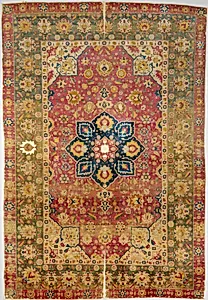
Silk Kashan Carpet
Unknown Artist
16th century
Medium
Silk (warp, weft and pile); asymmetrically knotted pile
Dimensions
Rug: H. 98 1/16 in. (249 cm) W. 67 5/16 in. (171 cm) Mount: H. 106 1/2 in. (270.5 cm) W. 75 1/4 in. (191.1 cm) D. 3 in. (7.6 cm) Object not yet weighed. Test lifted, Estimated weight 200lbs.
Classification
Textiles-Rugs
Department
Islamic Art
Museum
Metropolitan Museum of Art, New York, NY
Credit
Gift of Mrs. Douglas M. Moffat, 1958
Accession Number
58.46
Rights
Public Domain
Tags
Art Historical Context
This exquisite Silk Kashan Carpet, woven in 16th-century Persia, exemplifies the refined artistry of the Safavid era. Created entirely from silk in warp, weft, and pile using the asymmetrically knotted technique, rug’s delicate construction allowed for intricate detailing and a luxurious sheen that set it apart from more common woolen carpets. Its compact dimensions and vibrant floral motifs, featuring palmettes and blossoms, evoke the lush gardens celebrated in Persian poetry and design. Such silk carpets were rare luxuries, often commissioned for royal courts or as diplomatic gifts, reflecting the high status of textile arts in Islamic culture. The unknown weaver’s mastery of knotting and color harmony demonstrates the sophisticated workshops of Kashan, a renowned center for fine carpet production during this period. Today housed in the Metropolitan Museum of Art’s Islamic Art collection, this piece offers visitors a tangible connection to centuries-old traditions of craftsmanship and beauty. Its preservation highlights the enduring appeal of Persian rugs as both functional objects and works of art.