
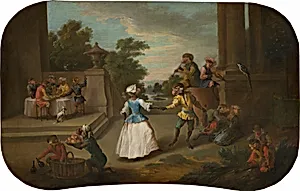
Singerie: The Dance
c. 1739
Medium
oil on canvas
Dimensions
overall: 92.1 x 144.4 cm (36 1/4 x 56 7/8 in.)
Classification
Painting
Department
CF
Museum
National Gallery of Art, Washington, D.C.
Credit
Gift of George D. Widener and Eleanor Widener Dixon
Accession Number
1957.7.2
Rights
Public Domain
Art Historical Context
Christophe Huet’s *Singerie: The* (c. 9) exemplifies the playful yet pointed spirit of eighteenth-century French decorative painting. The term “singerie” refers to scenes in which monkeys are dressed and posed as humans, a fashionable genre that gently satirized courtly manners and social pretensions. Here, elegantly attired simians cavort in a graceful dance, their exaggerated gestures mirroring the refined choreography of the period while underscoring its absurdity. Huet, active during the Rococo era, specialized in these whimsical animal tableaux. Oil on canvas allowed him to render the soft textures of fur, silk, and lace with luminous delicacy, inviting viewers to admire both the technical finesse and the humorous narrative. Such works often adorned the intimate salons of aristocratic patrons, blending entertainment with subtle social commentary. Beyond its charm, the painting reflects Enlightenment-era curiosity about the natural world and humanity’s place within it. By placing animals in human roles, Huet invites quiet reflection on behavior, hierarchy, and the thin line between civilization and instinct—qualities that continue to delight visitors today.
About the Artist
Christophe Huet · 1700–1759
Comment on works: Chinoiseries; arabesques; copper engraver; genre scenes; Chinese scenes; Animals; Monkeys; Flowers