
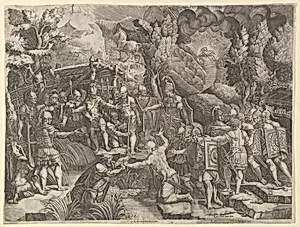
Sinon Deceiving the Trojans
mid-1540's
Medium
Engraving; fourth state of five
Dimensions
Sheet (Trimmed): 14 1/4 × 18 11/16 in. (36.2 × 47.5 cm)
Classification
Prints
Department
Drawings and Prints
Museum
Metropolitan Museum of Art, New York, NY
Credit
Harris Brisbane Dick Fund, 1953
Accession Number
53.601.30
Rights
Public Domain
Tags
Art Historical Context
In the mid-1540s, Italian engravers Giorgio Ghisi and Giovanni Battistaultori collaborated on *Sinon Deceiving the*, a dramatic engraving capturing a pivotal moment from Virgil's *Aeneid*. The depicts the Greek spy Sinon persuasively tricking the Trojans into accepting the wooden horse as a sacred offering, sealing Troy's fate in the legendary Trojan War. This fourth state of five reflects the meticulous evolution of printmaking, where subtle changes in lines and shading enhanced depth and narrative clarity across editions. Engravings like this one were revolutionary in the Renaissance, allowing widespread dissemination of classical myths to a burgeoning audience of scholars and collectors. Ghisi and Scultori, masters of the Mannerist style, employed intricate burin techniques to render dynamic figures, billowing drapery, and expressive gestures amid a bustling crowd of soldiers. The large sheet (14 1/4 × 18 11/16 in.) amplifies the epic scale, making it a standout in the Metropolitan Museum of Art's Drawings and Prints collection, acquired through the Harris Brisbane Dick Fund in 1953. This print not only revives ancient heroism and deception but also showcases how 16th-century artists bridged antiquity and modernity, inviting viewers to ponder timeless themes of cunning and downfall.
About the Artist
Giorgio Ghisi|Giovanni Battista Scultori · 1520–1582
Giorgio Ghisi (c. 1520–1582) was one of the most accomplished engravers of the Italian Renaissance, renowned for translating the monumental compositions of Raphael, Giulio Romano, and Michelangelo into the exacting medium of the burin. Born in Mantua, he trained in an environment shaped by the legacy of Giulio Romano's decoration of the Palazzo del Te, and the grandeur of that Mannerist tradition ...