
Sir Francis Bacon
1551 to 1600
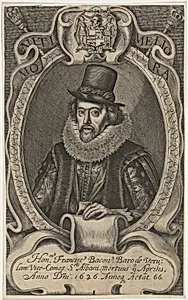
Medium
engraving
Dimensions
plate: 18.1 × 11.1 cm (7 1/8 × 4 3/8 in.)
Classification
Department
CG-E
Museum
National Gallery of Art, Washington, D.C.
Credit
Rosenwald Collection
Accession Number
1951.11.156
Rights
Public Domain
Art Historical Context
This elegant engraving, titled *Sir Francis Bacon*, captures the likeness of one of England's most influential Renaissance thinkers—a philosopher, statesman, and scientist who championed empirical methods and authored seminal works like *Novum Organum*. Created by the skilled Dutch engraver Simon de during the late 16th to early 17th century ( 1551–1600), it exemplifies the portrait print tradition that popularized elite figures across Europe. De Passe's mastery shines in the intricate line work of engraving, a technique where a burin carves fine grooves into a metal plate, allowing ink to hold and transfer detailed textures onto paper. At just 18.1 × 11.1 cm, this intimate print was likely produced for dissemination among scholars and collectors, making Bacon's stern gaze and fur-collared attire accessible beyond royal courts. Its precision reflects the era's growing demand for reproducible imagery amid the scientific revolution. Housed in the National Gallery of Art's Rosenwald Collection, this piece highlights the cultural bridge between Dutch printmaking prowess and English intellectual legacy, offering visitors a tangible link to the dawn of modern thought.
About the Artist
Simon de Passe · 1590–1647
Simon de Passe (c. 1595–1647), born in Cologne to the renowned Dutch engraver and publisher Crispijn van de Passe the Elder and his wife Magdalene, grew up in a family dynasty of printmakers who had fled Antwerp due to religious persecution as Anabaptists. The second son among five siblings—four of whom became engravers, including brothers Crispijn II and Willem, and sister Magdalena—he trained un...