
Sir Thomas Rumbold, Bt.
Medium
Oil on canvas
Dimensions
126.7 × 101.3 cm (49 7/8 × 39 7/8 in.)
Classification
oil on canvas
Department
Painting and Sculpture of Europe
Museum
Art Institute of Chicago
Accession Number
84707
Rights
Public Domain
Art Historical Context
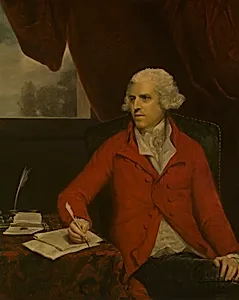
Sir Joshua Reynolds, one of Britain's greatest portrait painters and the first president of the Royal Academy of Arts, created *Sir Thomas Rumbold Bt.* in 1788, toward the end of his illustrious career. This oil-on-canvas portrait captures the sitter—a prominent British baronet and East India Company administrator—in a dignified half-length pose, measuring 126.7 × 101.3 cm. Reynolds' mastery shines through in the rich textures of fabric and skin, achieved via layered glazing and bold brushwork, hallmarks of his Grand Manner style that elevated British portraiture by drawing on classical antiquity and Old Masters like Titian and Van Dyck. Painted during the late Enlightenment era, amid Britain's expanding empire, the work reflects the era's fascination with status and achievement. Rumbold, known for his controversial governorship of Madras, embodies the ambitious colonial elite whose portraits Reynolds frequently immortalized for London's high society. The painting's scale and finish underscore its role as a symbol of power and legacy. Housed in the Art Institute of Chicago's Department of Painting and Sculpture of Europe, this piece exemplifies 18th-century oil portraiture's enduring appeal—its luminous quality inviting viewers to ponder the personal stories behind grand facades. A testament to Reynolds' influence on European art, it remains a captivating window into Georgian Britain's world of wealth and intrigue.
About the Artist
Sir Joshua Reynolds · 1723–1792
Sir Joshua Reynolds (1723–1792) was a British painter who became the dominant figure in eighteenth-century British art and the first president of the Royal Academy of Arts. Born in Plympton, Devon, he studied under the portrait painter Thomas Hudson in London, and a transformative visit to Italy (1749–52) — where he studied the Old Masters, particularly the Venetian colorists and Michelangelo — sh...