
William Thornton
1804
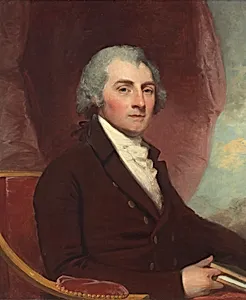
Medium
oil on canvas
Dimensions
overall: 73.2 x 61.9 cm (28 13/16 x 24 3/8 in.) framed: 89.9 x 77.8 x 10.6 cm (35 3/8 x 30 5/8 x 4 3/16 in.)
Classification
Painting
Department
CAB
Museum
National Gallery of Art, Washington, D.C.
Credit
Andrew W. Mellon Collection
Accession Number
1942.8.25
Rights
Public Domain
Art Historical Context
Behold Gilbert Stuart's captivating portrait of *William Thornton* (1804), an oil-on-canvas masterpiece measuring 73.2 x 61.9 cm, now housed in the National Gallery Art's Andrew W. Collection. Stuart, one of America's foremost portraitists of the Federal period, masterfully captures Thornton—renowned architect and the first superintendent of the U.S Capitol—with a poised gaze and dignified presence. Painted at the height of Stuart's career, this work exemplifies hislassical style, emphasizing clarity, realism, and psychological depth to honor early American luminaries. The oil medium allowed Stuart to achieve luminous skin tones and rich textures, hallmarks of his technique that brought sitters vividly to life. Completed in 1804, amid the young nation's expansion, the portrait reflects the era's optimism and cultural aspirations, immortalizing Thornton's contributions to iconic architecture like the Capitol dome. Its intimate scale invites viewers to connect with history, evoking the refinement of early 19th-century portraiture. Displayed in the museum's American art department, this painting from the prestigious Mellon Collection underscores Stuart's enduring legacy in shaping America's visual identity. A must-see for those exploring the roots of national pride!
About the Artist
Gilbert Stuart · 1755–1828
Gilbert Stuart (1755–1828) was born on December 3, 1755, in Saunderstown, Rhode Island. He received his first painting instruction from local portraitist Samuel King, then studied under Scottish artist Cosmo Alexander who brought him to Scotland in 1771. After Alexander died, Stuart returned to Newport before sailing to London in 1775, where he entered the studio of Benjamin West for approximately...