
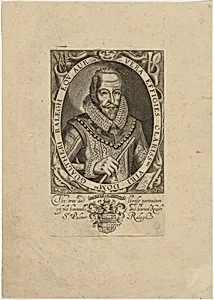
Sir Walter Raleigh
published 1687
Medium
engraving
Dimensions
plate: 18.2 × 11.2 cm (7 3/16 × 4 7/16 in.)
Classification
Department
CG-E
Museum
National Gallery of Art, Washington, D.C.
Credit
Rosenwald Collection
Accession Number
1951.11.233
Rights
Public Domain
Art Historical Context
This engraving of Sir Walter Raleigh, created by Simon de Passe and published in 1687, offers a window into the enduring fascination with one of Elizabethan England’s most colorful figures. Though Raleigh had passed away decades earlier, the print kept his image alive for new generations, capturing the explorer, courtier, and writer in a dignified pose that reflects his legendary status. As a work on paper from the Rosenwald Collection at the National Gallery of Art, it highlights how portrait prints helped shape public memory long after a subject’s lifetime. De Passe, a skilled Dutch engraver who worked extensively in England, specialized in detailed portraiture that blended precision with subtle expressiveness. The engraving technique allowed fine lines and textures to be reproduced in multiple impressions, making such images widely accessible beyond the elite circles that could afford painted portraits. At just over seven inches tall, this intimate plate size suited book illustrations or personal collections, underscoring the print’s role in democratizing historical imagery during the late seventeenth century. Visitors can appreciate how this modest yet elegant work connects artistic craftsmanship with cultural legacy, preserving Raleigh’s likeness through a medium prized for both accuracy and affordability.
About the Artist
Simon de Passe · 1590–1647
Simon de Passe (c. 1595–1647), born in Cologne to the renowned Dutch engraver and publisher Crispijn van de Passe the Elder and his wife Magdalene, grew up in a family dynasty of printmakers who had fled Antwerp due to religious persecution as Anabaptists. The second son among five siblings—four of whom became engravers, including brothers Crispijn II and Willem, and sister Magdalena—he trained un...