
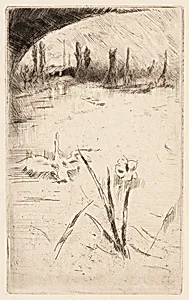
Sketch after Cecil Lawson's "Swan and Iris"
Medium
Etching and drypoint with foul biting in black ink on cream Japanese paper
Dimensions
Plate: 13.5 × 8.4 cm (5 3/8 × 3 5/16 in.); Sheet: 21.2 × 14.6 cm (8 3/8 × 5 3/4 in.)
Classification
etching
Department
Prints and Drawings
Museum
Art Institute of Chicago
Accession Number
73485
Rights
Public Domain
Art Historical Context
In the Prints and Drawings department of the Art Institute of Chicago, James McNeill Whistler's *Sketch after Cecil Lawson's "Swan and Iris"* (1882) captures the artist's fascination with fellow British painter Cecil Lawson's poetic landscape. Whistler, a leading figure in the Aesthetic movement and champion of "art for art's sake," created this intimate etching as a homage or study, translating Lawson's delicate imagery of a swan amid irises into his own precise, evocative line work. At just 13.5 × 8.4 cm on the plate, it exemplifies Whistler's mastery of small-scale printmaking during a prolific period following his earlier Thames etchings. Rendered in black ink on luxurious cream Japanese paper—a material Whistler prized for its soft absorbency and subtle texture—the work combines etching, drypoint, and incidental "foul biting." Etching uses acid to bite fine lines into a metal plate, while drypoint's direct needle scratches produce velvety burrs for richness. Foul biting, an unplanned corrosion, adds atmospheric texture, enhancing the misty, harmonious mood Whistler favored over narrative detail. This modest yet masterful sheet highlights Whistler's innovative print techniques, bridging 19th-century British art scenes and influencing modern graphic arts with its emphasis on tonal subtlety and beauty over realism. A gem for print enthusiasts!
About the Artist
James McNeill Whistler · 1834–1903
James Abbott McNeill Whistler (1834-1903) was an American-born painter and printmaker who became a leading figure in the Aesthetic Movement and pioneer of Tonalism and Japonisme. He revolutionized art by championing "art for art's sake" and treating paintings as visual equivalents of musical compositions, titling works as "arrangements," "harmonies," and "nocturnes" to emphasize formal qualities o...