
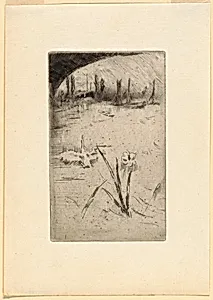
Sketch after Cecil Lawson's "Swan and Iris"
Classification
landscapes
Department
Smithsonian Collection
Museum
Smithsonian American Art Museum
Credit
Gift of Mrs. David Keppel
Accession Number
1957-168-3
Rights
Public Domain
About this artwork
Research in Progress
Art Historical Context
James McNeill Whistler, renowned American artist (1834–1903) who made his home in Britain, created this delicate sketch in 1882 a study after Cecil Lawson's evocative painting *Swan and Iris*. Whistler, a pioneer of the Aesthetic movement, championed "art for art's," prioritizing harmony of tone, color, and form over narrative. Though best known for his atmospheric nocturnes and subtle portraits—like his iconic *Arrangement in Grey and Black No. 1* (often called *Whistler's Mother*)—this landscape sketch reveals his fascination with nature's poetic beauty and his practice of closely observing admired contemporaries. Lawson, a promising British landscapist influenced by Pre-Raphaelite ideals, tragically died that same year at age 32, making Whistler's homage a poignant artistic dialogue. Classified as a landscape, the work highlights Whistler's fluid line work and tonal sensitivity, techniques honed during his Paris training and etched plates. Though the medium remains unidentified amid ongoing research, such sketches offer rare glimpses into his preparatory process. Housed in the Smithsonian American Art Museum as a gift from Mrs. David Keppel, this piece invites visitors to appreciate Whistler's versatility and the cross-pollination of late 19th-century art worlds. Imagine the swan gliding amid irises—a symbol of fleeting grace that echoes Whistler's own pursuit of ephemeral beauty.