
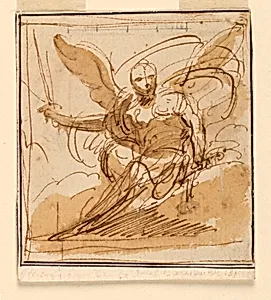
Sketch for a Wall Painting
early 19th century
Classification
interiors
Department
Smithsonian Collection
Museum
Smithsonian American Art Museum
Credit
Museum purchase through gift of various donors
Accession Number
1901-39-1711
Rights
Public Domain
About this artwork
Research in Progress
Art Historical Context
Giuseppe Bernardino Bison (1762–1844), a prolific Venetian artist of the late Neoclassical era, created this *Sketch for a Wall Painting in the early 19 century. Working primarily in Venice during a time of political upheaval—following Napoleonic rule and the rise of Austrian dominance—Bison specialized in decorative schemes for palaces, theaters, and churches. His sketches like this one served as vital blueprints for grand frescoes and murals, capturing intricate interior designs that blended architectural elegance with illusionistic depth. Classified under "interiors," this preparatory drawing highlights Bison's mastery of spatial illusion and ornamental detail, hallmarks of Venetian decorative painting. Though the medium remains unidentified amid ongoing research, such sketches often employed quick, fluid lines in pen, ink, or wash to convey light, shadow, and perspective—techniques that brought static walls to vibrant life. Bison's style bridged Neoclassicism's measured symmetry with emerging Romantic flourishes, influencing interior decoration across Italy. Acquired by the Smithsonian American Art Museum through donor gifts, this work offers a glimpse into the creative process behind Europe's opulent 19th-century interiors. As research progresses, it invites visitors to appreciate the artistry in planning grandeur, reminding us how sketches like Bison's laid the foundation for immersive environments that still inspire today.