
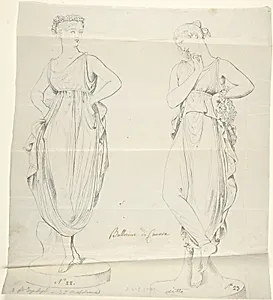
Sketch of Two Statues: Ballerinas by Canova
ca. 1850
Medium
Graphite, with inscriptions in pen and brown ink
Dimensions
sheet: 8 3/8 x 7 1/2 in. (21.2 x 19 cm)
Classification
Drawings
Department
Drawings and Prints
Museum
Metropolitan Museum of Art, New York, NY
Credit
Gift of Mrs. John De Witt Peltz, 1977
Accession Number
1977.382.8
Rights
Public Domain
Tags
Art Historical Context
Behold this delicate graphite sketch, *Sketch of Two Statues Ballerinas by Can*, created around 1850 by British sculptor John Gibson, a devoted pupil of the neoclassical master Antonio Canova Captured on a modest 8 3/8 x 7 1/2-inch sheet, it depicts a pair of Canova's graceful ballerina figures—elegant embodiments of neoclassicism's ideal of poised femininity and dynamic movement. Gibson's lines, enhanced by pen and brown ink inscriptions, his intimate study of his mentor's work, likely drawn from memory or direct observation during his time in Canova's Rome studio. Canova (1757–1822), the preeminent sculptor of his era, revolutionized marble carving with ballerina statues that evoked ancient Greek grace while celebrating 19th-century ballet's rising popularity. Gibson (1790–1866), who succeeded Canova in Rome, preserved this legacy through such preparatory drawings, blending graphite's soft subtlety with ink's precision for quick, expressive notation. Housed in the Metropolitan Museum of Art's Drawings and Prints department, this gift from Mrs. John De Witt Peltz in 1977 offers a window into the transmission of neoclassical ideals across generations. As a study of female form amid cultural shifts toward Romanticism, the sketch highlights the enduring allure of dance in art, inviting us to appreciate the pencil's power in immortalizing sculpture.
About the Artist
John Gibson|Antonio Canova · 1790–1866
Outstanding Neoclassical sculptor who experimented with the ancient practice of coloring statues, e.g. his 'Tinted Venus' (1851). Flaxman encourgaged him to go to Rome, where he spent most of his life. He left his fortune to the National Gallery, London. British sculptor, active Rome. Comment on works: sculptor