
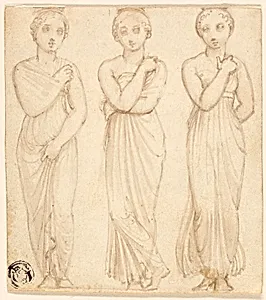
Three Draped Female Figures
n.d.
Medium
Pen and brown ink with brush and brown wash, on cream wove paper
Dimensions
10.6 × 9.5 cm (4 3/16 × 3 3/4 in.)
Classification
pen and ink drawings
Department
Prints and Drawings
Museum
Art Institute of Chicago
Accession Number
83432
Rights
Public Domain
Art Historical Context
Thomas Stothard (1755–1834), a prominent British artist of the Romantic era, was renowned for his delicate illustrations and history paintings inspired by classical mythology, literature, and everyday grace. This undated drawing, *Three Draped Female Figures*, exemplifies his mastery of the human form in small-scale studies. Rendered on cream wove paper in pen and brown ink with brush and brown wash, the intimate 10.6 × 9.5 cm sheet captures three ethereal women in flowing classical drapery, likely preparatory sketches for larger compositions such as book illustrations or canvases—Stothard contributed to over 100 illustrated volumes, including works by Shakespeare and Milton. The technique highlights Stothard's fluid line work and subtle tonal modeling: fine pen strokes define contours and folds, while the brown wash adds depth and luminosity, evoking the soft interplay of light on fabric. This neoclassical approach, blending elegance with romantic sensibility, reflects early 19th-century British taste for antique-inspired figures, bridging the Enlightenment's rationalism and emerging emotionalism. Housed in the Art Institute of Chicago's Prints and Drawings department, this gem offers a window into Stothard's prolific studio practice, where such preparatory works fueled his fame at the Royal Academy. Visitors appreciate its portability and poise, a testament to how intimate sketches immortalize timeless beauty.
About the Artist
Thomas Stothard · 1755–1834
Thomas Stothard RA (1755–1834) was born on 17 August 1755 at the Black Horse Inn in London's Long Acre, the son of a prosperous publican originally from Stutton near Tadcaster. A delicate child, he was sent at age five to relatives in Yorkshire, attending schools in Acomb, Tadcaster, and later Ilford, Essex, where he honed his drawing skills by copying prints. Following his father's death in 1770,...