
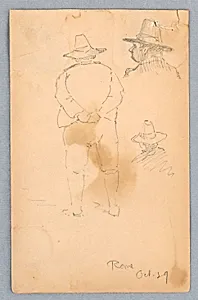
Sketches of a Man, Rome
Medium
figures
Classification
figures
Department
Smithsonian Collection
Museum
Smithsonian American Art Museum
Credit
Smithsonian American Art Museum
Accession Number
1914-38-349
Rights
Public Domain
About this artwork
Research in Progress
Art Historical Context
**Sketches of a Man Rome** *Francis Augustus Lathrop (, 1849–1909), ca. 1883* *Figures; Smithsonian American Art Museum* Augustus Lathrop, a prominent American artist of the Aesthetic Movement, created these sketches during a formative period around 1883 while in Rome, a timeless hub for artists seeking inspiration from classical antiquity. Born in New York and trained in Europe, Lathrop was influenced by Pre-Raphaelite ideals, emphasizing meticulous detail and naturalism. His travels to Italy reflect the 19th-century tradition of American artists journeying abroad to study the human form amid Rome's vibrant street life and ancient ruins, honing skills for larger paintings, murals, and illustrations. These quick studies of a man capture Lathrop's keen observational eye, likely rendered in pencil or charcoal on paper—a common medium for figure sketches that allowed rapid gesture and proportion work. Such preparatory drawings were essential for artists like Lathrop, who later excelled in symbolic, decorative works for institutions like Trinity Church in Boston. The Roman setting adds cultural depth, evoking the city's role as a muse for capturing everyday humanity against an eternal backdrop. Though research on this piece continues, it offers a window into Lathrop's European sojourn and the transatlantic exchange of artistic techniques. Imagine the bustling Roman piazza where this anonymous figure posed— a testament to art's power to freeze fleeting moments. (198 words)