
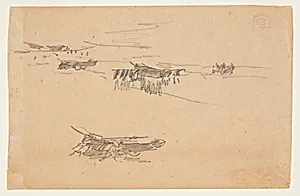
Sketches of Dories on Carriages
Classification
seascapes
Department
Smithsonian Collection
Museum
Smithsonian American Art Museum
Credit
Gift of Charles Savage Homer, Jr.
Accession Number
1912-12-240
Rights
Public Domain
About this artwork
Research in Progress
Art Historical Context
Winslow Homer, a towering figure in American Realism, captured the rugged beauty of the sea in *Sketches of Dories on Carriages* from 1881. Known for his masterful depictions of coastal life, Homer had recently settled in Prouts Neck, Maine, immersing himself in the dramatic interplay of ocean, sky, and hardworking fishermen. These sketches reflect his keen observation of everyday maritime scenes, where dories—simple, flat-bottomed fishing boats—rest on wheeled beach carriages used for launching into the surf. As quick studies, likely in pencil or charcoal (medium to be confirmed), the works showcase Homer's technique of direct, unembellished rendering, prioritizing form and movement over finish. This aligns with his shift toward watercolor and oil seascapes in the 1880s, where he elevated ordinary subjects into symbols of human resilience against nature's power. Dories, ubiquitous in New England fisheries, symbolize the perilous yet vital bond between man and sea in Homer's oeuvre. A gift to the Smithsonian American Art Museum from Homer's family, these sketches offer a rare glimpse into the artist's process during a pivotal creative period. They invite visitors to appreciate the raw energy behind his iconic paintings, bridging the gap between sketchbook and canvas.