
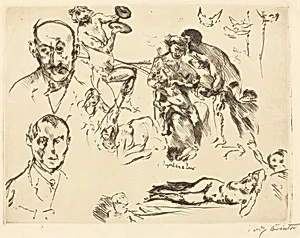
Sketches of Men, including Max Liebermann
c. 1915
Medium
etching in black
Classification
Department
CG-W
Museum
National Gallery of Art, Washington, D.C.
Credit
Gift of Jacob Kainen
Accession Number
2002.98.267
Rights
Public Domain
Art Historical Context
Lovis Corinth's *Sketches of Men, including Max Liebermann*c. 1915) captures the camaraderie of Germany's vibrant art scene during the turbulent years of World War I As a leading figure in the Berlin Secession—a progressive movement challenging academic traditions—Corinth blended Impressionist influences with his evolving Expressionist style, marked by bold, fluid lines and emotional intensity. This etching features informal portraits of fellow artists, notably Max Liebermann, the esteemed Impressionist and Secession president, highlighting the mutual respect among these innovators amid societal upheaval. Rendered in black etching, the work showcases Corinth's mastery of printmaking techniques. Etching involves incising lines into a metal plate with acid, allowing for rich, velvety textures and spontaneous energy that mimic his loose drawing style. These sketches reveal his skill in distilling personality through minimal strokes—expressive faces and gestures that convey vitality and introspection. Housed in the National Gallery of Art as a gift from Jacob Kainen, this print offers a window into early 20th-century German modernism. It underscores the era's artistic exchanges, preserving a moment when figures like Corinth and Liebermann pushed boundaries, influencing generations of printmakers with their innovative approaches.
About the Artist
Lovis Corinth · 1858–1925
Lovis Corinth, born Franz Heinrich Louis on July 21, 1858, in Tapiau, East Prussia (now Gvardeysk, Russia), to a tanner father, displayed prodigious drawing talent from childhood. He began formal training at the Königsberg Academy in 1876, then moved to the Academy of Fine Arts in Munich from 1880 to 1884, studying under Ludwig von Löfftz and briefly Franz von Defregger, where he absorbed a Realis...