
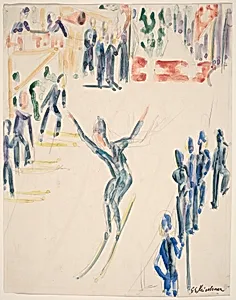
Ski Jumper
c. 1936
Medium
watercolor and graphite on board
Dimensions
sheet: 39.8 × 30.9 cm (15 11/16 × 12 3/16 in.)
Classification
Drawing
Department
CG-W
Museum
National Gallery of Art, Washington, D.C.
Credit
Gift of Ruth Cole Kainen
Accession Number
2012.92.673
Rights
Public Domain
Art Historical Context
Ernst Ludwig Kirchner's *Ski Jumper* (c. 1936) captures the exhilarating motion of a figure soaring through the air on skis, rendered in vibrant watercolor and precise graphite lines on board. Measuring about 15 11/16 × 12 3/16 inches, this dynamic drawing exemplifies Kirchner's late style, where the raw emotional intensity of his early Expressionist years softens into lyrical, fluid forms inspired by the Swiss Alps. A co-founder of the Die Brücke group, Kirchner pioneered German Expressionism with its bold colors and distorted perspectives to convey inner turmoil. By 1936, however, he had fled Nazi persecution—his work was labeled "degenerate art"—and settled in Davos, Switzerland. There, alpine sports like skiing became recurring motifs, symbolizing freedom and vitality amid personal exile. The watercolor's translucent washes evoke snowy expanses and speed, while graphite adds sharp definition to the jumper's tensed body and arched skis. This intimate drawing, now a gift of Ruth Cole Kainen in the National Gallery of Art's collection, highlights Kirchner's technical mastery in mixed media. It invites viewers to feel the rush of winter air, bridging his revolutionary past with a poignant search for harmony in nature.
About the Artist
Ernst Ludwig Kirchner · 1880–1938
Ernst Ludwig Kirchner was born on May 6, 1880, in Aschaffenburg, Germany, to parents Ernst and Maria Kirchner, part of a family of Prussian descent that frequently relocated due to his father's career as a chemical technician. After early schooling in various towns, he studied architecture at the Königliche Technische Hochschule (Technical University) in Dresden from 1901 to 1905, taking courses i...