
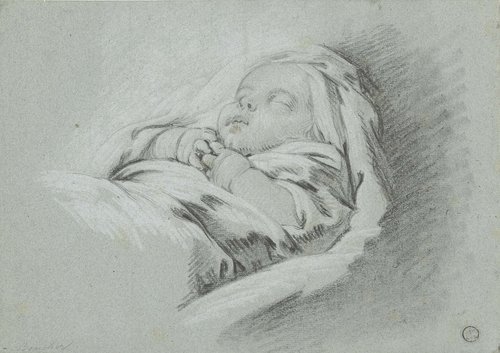
Slapende baby, de handjes over elkaar
1713 - 1770
Medium
paper
Dimensions
234; 331
Rights
Public Domain
About this artwork
collector's mark, recto, lower right: Lugt 1492
Art Historical Context
**Slapende baby, de handjes over** *François Boucher (1703–1770)* *Paper, h 234mm × w 331mm* François Boucher, a of the Rococo style captures an intimate moment of innocence in this delicate drawing titled *Slapende baby, handjes over elkaar*Dutch for "Sleeping Baby, the Hands Over Each Other." The work depicts a peacefully slumbering infant with tiny hands gently clasped, evoking tenderness the quiet beauty of childhood. Boucher's Rococo sensibility shines through in its soft, playful charm, a hallmark of his oeuvre filled with lighthearted scenes that graced the French court under Louis XV. Executed on paper, this modest-sized sheet (roughly 9 x 13 inches) highlights the artist's prowess in preparatory sketches and standalone drawings, which were highly prized in 18th-century Europe for their spontaneity and finesse. Boucher, favored by Madame de Pompadour, often used such works to explore themes of domestic bliss amid his more ornate paintings of mythology and pastoral idylls. The presence of a collector's mark (Lugt 1492) on the lower right verso underscores its esteemed provenance, linking it to generations of connoisseurs who valued Boucher's fluid lines and emotional warmth. This piece invites visitors to appreciate Rococo's celebration of everyday grace, reminding us how a simple sleep can embody timeless serenity.
About the Artist
François Boucher · 1703–1770
François Boucher (1703–1770) stands as the quintessential master of French Rococo painting and the most celebrated decorative artist of the 18th century. Born in Paris to a lace designer, Boucher created a visual language that perfectly embodied the refined taste, sensuality, and elegance of Louis XV's court. His prolific output—encompassing paintings, tapestry designs, theatrical sets, and decora...