
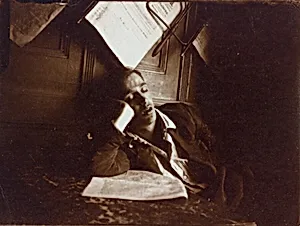
Sleeping Boy
1912
Medium
gelatin silver print
Dimensions
sheet: 4.4 x 5.9 cm (1 3/4 x 2 5/16 in.)
Classification
Photograph
Department
CPH
Museum
National Gallery of Art, Washington, D.C.
Credit
Gift of The André and Elizabeth Kertész Foundation
Accession Number
2000.170.1
Rights
Public Domain
Art Historical Context
In the intimate confines of this tiny gelatin silver print, *Sleeping Boy* (1912) captures a moment of serene vulnerability by Hungarian-born photographer André Kertész. Measuring just 4.4 x 5.9 cm, the image invites viewers to lean in close, much like peering into a private world. Created when Kertész was only 18 and just beginning his photographic journey with a simple glass-plate camera, it exemplifies his early instinct for finding beauty in the everyday. Kertész, a pioneer of modernist photography, favored candid, unposed scenes over staged portraits, a style that would define his influential career after emigrating to Paris and later New York. Shot in Hungary on the eve of World War I, this work reflects a prewar innocence, emphasizing quiet human moments amid a changing Europe. The gelatin silver process, standard for its era, delivers exceptional tonal range and fine detail, rendering the boy's soft features and relaxed form with remarkable clarity. Today, housed in the National Gallery of Art as a gift from The André and Elizabeth Kertész Foundation (Department of Photographs), *Sleeping Boy* reminds us of photography's power to preserve fleeting tenderness. It's a testament to Kertész's lifelong philosophy: "I am not trying to be artistic. I am trying to express my feeling."
About the Artist
André Kertész · 1894–1985
André Kertész, born Andor Kertész on July 2, 1894, in Budapest, Hungary, to a middle-class Jewish family, initially pursued a conventional path as a clerk at the Budapest Stock Exchange after graduating from the Academy of Commerce in 1912. Self-taught in photography after purchasing his first camera that year, he captured his early poetic visions of Hungarian landscapes and peasant life, includin...