
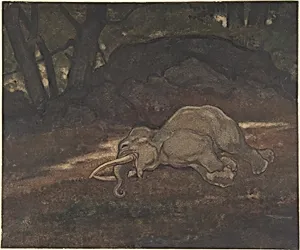
Sleeping Elephant
1810–75
Medium
Watercolor on wove paper
Dimensions
Sheet: 9 13/16 x 11 3/4 in. (24.9 x 29.9cm)
Classification
Drawings
Department
Drawings and Prints
Museum
Metropolitan Museum of Art, New York, NY
Credit
H. O. Havemeyer Collection, Bequest of Mrs. H. O. Havemeyer, 1929
Accession Number
29.100.582
Rights
Public Domain
Tags
Art Historical Context
Antoine-Louis Barye a pioneering French animalier sculptor of the Romantic era (1796–1875), captured the serene vulnerability of wildlife in *Sleeping Elephant*, a delicate watercolor on wove paper his active years. Measuring just under 10 by 12 inches, this intimate drawing showcases a majestic elephant in peaceful repose, highlighting Barye's lifelong fascination with animal anatomy and behavior. Trained as a goldsmith before turning to sculpture, Bary drew directly from live models at the Paris zoos, infusing his works with lifelike realism that bridged Romantic expressiveness and emerging scientific precision. Rendered in watercolor—a medium Barye favored for its luminous transparency and fluid layering—the piece exemplifies his masterful use of subtle washes to evoke the elephant's heavy, relaxed form and textured hide. Wove paper's smooth surface allowed for fine detailing without the interruptions of laid paper, enhancing the work's ethereal quality. This study likely served as preparation for his bronze sculptures, where elephants symbolized exotic power and exoticism in 19th-century European art. Now housed in The Metropolitan Museum of Art's Drawings and Prints department, *Sleeping Elephant* entered the collection via the renowned H. O. Havemeyer bequest in 1929. It invites visitors to ponder the quiet majesty of nature, a theme central to Barye's legacy as the "Michelangelo of animal sculpture."
About the Artist
Antoine-Louis Barye · 1795–1875
Antoine-Louis Barye (1795–1875) was born in Paris on September 24, the son of goldsmith Pierre Barye and Marguerite Barye. Following family tradition, he apprenticed as a goldsmith under his father and, around 1810, with Martin-Guillaume Biennais, goldsmith to Napoleon. After brief military service, Barye pursued sculpture, studying under François-Joseph Bosio in 1816 and painter Baron Antoine-Jea...