
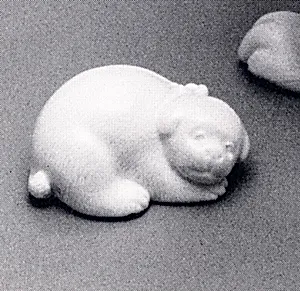
Sleeping puppy
Unknown Artist
ca. 1850
Medium
Molded porcelain form with incised details (Hirado ware)
Dimensions
H. 7/8 in. (2.3 cm); W. 1 7/8 in. (4.8 cm); D. 1 5/16 in. (3.3 cm)
Classification
Ceramics
Culture & Period
Japan · Edo period (1615–1868)
Department
Asian Art
Museum
Metropolitan Museum of Art, New York, NY
Credit
Dr. and Mrs. Roger G. Gerry Collection, Bequest of Dr. and Mrs. Roger G. Gerry, 2000
Accession Number
2002.447.127
Rights
Public Domain
Tags
Art Historical Context
Nestled in the Asian Art galleries of the Metropolitan Museum of, this enchanting *Sleeping Puppy* (ca. 1850) captures a moment of pure tranquility in molded porcelain from Japan's Hirado kilns. Measuring just 7/8 inch high, this diminutive figurine—barely larger than a walnut—showcases the exquisite finesse of Edo-period (1615–1868) ceramics. The unknown artist employed precise molding techniques and incised details to render the puppy's soft fur, curled form, and peaceful repose, highlighting the material's ivory-white translucency. Hirado ware, produced on the island of Hirado in Nagasaki, was renowned for such delicate, naturalistic animal figures during the late Edo era. These small-scale works often served as decorative objects or curios, reflecting Japan's mastery of porcelain craftsmanship amid growing international trade influences. The technique of molding allowed for intricate, repeatable designs while incising added lifelike texture, embodying the period's appreciation for whimsy and realism in everyday subjects like beloved pets. A bequest from the Dr. and Mrs. Roger G. Gerry Collection (2000), this puppy invites visitors to marvel at how something so tiny evokes universal tenderness. Dogs, symbols of loyalty in Japanese culture, come alive here in serene slumber, bridging art and affection across centuries.