
Sleutel
Unknown Artist
c. 1400 - c. 1950
Medium
bronze (metal)
Dimensions
10; 4.1
Rights
Public Domain
About this artwork
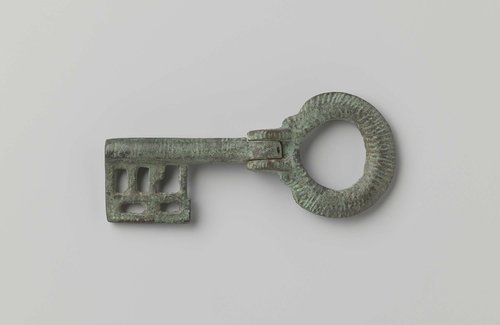
Pijpsleutel met scharnierverbinding. De platte ringvormige greep is over de breedte gearceerd en onderaan met ingehamerde cirkeltjes voorzien. De schacht is regelmatig gegroefd.
Art Historical Context
Behold the intriguing "Sleutel," a bronze pipe key crafted by an unknown artisan between circa 1400 and 1950. Measuring a compact 10 cm in length and 4.1 cm in width, this artifact exemplifies the enduring design of European locksmithing. Its flat, ring-shaped handle features intricate cross-hatching across its width, accented at the base with meticulously hammered circles, while the shaft bears regular grooves for a secure grip and precise operation. A distinctive hinged connection adds mechanical sophistication, allowing the key to fold or adjust as needed. Dating from the late medieval period through the early 20th century, this key reflects centuries of metallurgical craftsmanship in bronze—a durable alloy prized for its corrosion resistance and ability to capture fine details through casting and chasing techniques. Such pipe keys, with their tubular shanks, were common in Europe for securing chests, doors, and cabinets, blending utility with subtle ornamentation. The decorative elements, like the grooved textures and dotted motifs, hint at regional workshops where everyday tools doubled as miniature sculptures. In a museum setting, "Sleutel" invites us to appreciate the artistry in the mundane. These unassuming objects carried profound cultural weight, symbolizing access, security, and status across eras. Its broad chronology underscores how traditional forms persisted, evolving subtly amid technological shifts, offering a tangible link to the hands that once turned it.