
Sleutel
Unknown Artist
c. 1500 - c. 1600
Medium
iron (metal)
Dimensions
11.4; 2.8
Rights
Public Domain
About this artwork
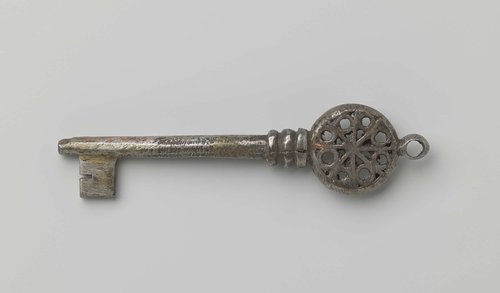
"Venetiaansche sleutel" met roos in de ronde greep, bekroond door een oogje. De sleutel moet later bijgevijld en de baard een nieuwe vorm gegeven zijn.
Art Historical Context
### Sleutel (Key), c. 1500–1600 This charming iron key, known as a "Venetiaansche sleutel" or Venetian key, dates to the Renaissance era (c. 1500–1600) and measures a compact 11.4 cm long by 2.8 cm wide. Crafted from durable iron—a practical choice for everyday security in an age of wooden doors and bustling trade ports—its round handle features a delicate rose motif, topped by a small eye or loop for easy handling or attachment. Such decorative elements elevated functional objects into subtle works of art, reflecting the era's blend of utility and ornamentation. Hailing from Venice, a thriving maritime republic famed for its locks, bridges, and mercantile wealth, this key offers a glimpse into 16th-century daily life. Venetian keys were essential for safeguarding homes, workshops, and warehouses amid the city's canals and crowded alleys. The iron medium highlights skilled metalworking techniques: likely forged initially, then meticulously filed and reshaped in the bit (or "beard") at a later date, suggesting generations of use and repair that speak to its enduring value. As a humble yet evocative artifact, the *Sleutel* underscores how ordinary tools carried cultural weight—symbols of access, trust, and craftsmanship in Renaissance Europe. Though by an unknown artisan, its survival invites us to ponder the hands that turned it over centuries. (198 words)