
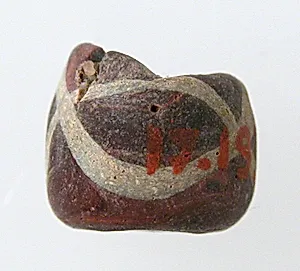
Small Bead
Unknown Artist
500–600
Medium
Glass
Dimensions
Overall: 3/16 x 3/16 in. (0.4 x 0.5 cm)
Classification
Glass-Beads
Culture
Frankish
Department
Medieval Art
Museum
Metropolitan Museum of Art, New York, NY
Credit
Gift of J. Pierpont Morgan, 1917
Accession Number
17.193.15
Rights
Public Domain
Art Historical Context
Nestled in the Metropolitan Museum of Art's Medieval Art collection, this diminutive *Small Bead* from the Frankish culture (circa 500–600 CE) exemplifies the exquisite craftsmanship of early medieval artisans. Measuring just 3/16 x 3/16 inches (0.4 x 0.5 cm), this glass bead—gifted by J. Pierpont Morgan in 1917—was likely part of jewelry, clothing adornments, or trade goods in the Merovingian Frankish Kingdom, which spanned much of modern-day France and Germany after the fall of Rome. Glass beads like this one were produced using sophisticated techniques, such as trailing molten glass around a metal wire or molding it in clay molds, then annealing to prevent cracking. Their vibrant colors and translucency, achieved through mineral additives, made them prized status symbols and amulets, reflecting extensive trade networks from the Mediterranean to northern Europe. Though tiny, this bead reveals the Frankish people's mastery of glassworking, a skill inherited from Roman traditions and adapted for a new era. Don't overlook these "small wonders"—they offer a window into daily life 1,500 years ago, where even the humblest objects carried artistic and cultural weight. Pause to marvel at its enduring sparkle!