
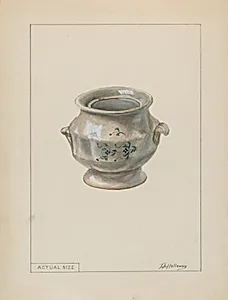
Small Sugar Bowl
c. 1936
Medium
watercolor and graphite on paperboard
Dimensions
overall: 30.9 x 22.8 cm (12 3/16 x 9 in.) Original IAD Object: Bowl rendered actual size.
Classification
Index of American Design
Department
CG-W
Museum
National Gallery of Art, Washington, D.C.
Credit
Index of American Design
Accession Number
1943.8.7325
Rights
Public Domain
Art Historical Context
Thomas Holloway's "Small Sugar Bowl," created around 1936, captures the quiet elegance of everyday American domestic objects through meticulous detail. As part of the Index of American Design, a federal project under the Works Progress Administration, this work belongs to a vast archive that documented historic American decorative arts during the Great Depression. Artists like Holloway produced faithful renderings to preserve cultural heritage at a time when many original artifacts faced loss or neglect. Executed in watercolor and graphite on paperboard, the drawing measures just over 12 by 9 inches, matching the bowl's actual size for accuracy. This combination of media allowed for both precise line work and subtle tonal shading, highlighting the object's form, texture, and proportions without exaggeration. Such techniques were essential to the Index's mission of creating a reliable visual record for future study and appreciation. Today, housed in the National Gallery of Art, the piece offers viewers a window into 1930s efforts to celebrate America's material culture. It transforms a simple sugar bowl into an emblem of thoughtful design and national identity, inviting reflection on the artistry found in ordinary household items.