
Sugar Bowl
c. 1930
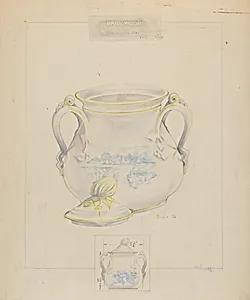
Medium
watercolor and graphite on paper
Dimensions
overall: 28 x 30.5 cm (11 x 12 in.) Original IAD Object: 5 1/2" High 5 3/4" Wide
Classification
Index of American Design
Department
CG-W
Museum
National Gallery of Art, Washington, D.C.
Credit
Index of American Design
Accession Number
1943.8.7260
Rights
Public Domain
Art Historical Context
This precise watercolor and graphite drawing, titled Sugar Bowl, was created around 1930 by Joseph Sudek. Measuring 28 by 30.5 cm, it faithfully records a modest household object originally 5½ inches high and 5¾ inches wide. The combination of transparent watercolor washes and fine graphite lines captures the vessel’s contours, volume, and surface details with quiet accuracy. The work belongs to the Index of American Design at the National Gallery of Art, a collection assembled to preserve visual records of American decorative arts and everyday objects. Such renderings served as both artistic studies and historical documents, allowing later generations to appreciate the craftsmanship of ordinary items from the early twentieth century. Through its careful technique, the drawing transforms a simple sugar bowl into an object of contemplative beauty, inviting viewers to notice the elegance found in functional design. It stands as a testament to the value of close observation and the enduring appeal of well-made domestic ware.
About the Artist
Joseph Sudek
Josef Sudek (1896–1976) was a Czech photographer widely regarded as one of the greatest photographers of the twentieth century, known for his poetic, intimate images of Prague and his mastery of light. Born in Kolín, Bohemia, he lost his right arm during World War I and turned to photography during his convalescence, studying at the State School of Graphic Arts in Prague from 1922 to 1924. Sudek ...