
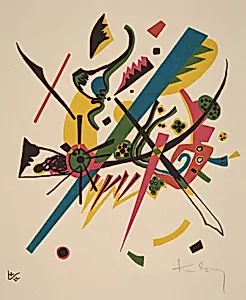
Small Worlds I
Medium
4-color lithograph
Dimensions
image: 27.2 x 23.3 cm (10 11/16 x 9 3/16 in.) sheet: 36 x 31.3 cm (14 3/16 x 12 5/16 in.)
Classification
Department
CG-W
Museum
National Gallery of Art, Washington, D.C.
Credit
Print Purchase Fund (Rosenwald Collection)
Accession Number
1971.9.1
Rights
Public Domain
Art Historical Context
Step into the abstract universe of Wassily Kandinsky *Small Worlds I* (1922), a 4-color lithograph exemplifies the Russian artist's pioneering role in non-objective art. By the early 1920s, Kandinsky had fully embraced pure abstraction at the Bauhaus school in Weimar, Germany, where taught alongside luminaries like Paul Klee. This print, measuring 27.2 x 23.3 cm, evokes microscopic realms through floating geometric forms—circles, triangles, and interlocking lines—in bold primaries and contrasts, suggesting cosmic harmony and spiritual introspection. Printed via lithography, a technique Kandinsky mastered for disseminating his revolutionary ideas, *Small Worlds I* uses four stones to layer vibrant hues, making abstraction accessible beyond elite canvases. Part of his "Small Worlds" series, it reflects the era's fascination with the unseen—quantum theories and mystical philosophies—transforming personal vision into universal language. Acquired through the Print Purchase Fund (Rosenwald Collection) at the National Gallery of Art, this work highlights how prints democratized modernism post-World War I. Today, it invites visitors to ponder Kandinsky's belief that color and form resonate like music, stirring the soul without mimicking reality. A gateway to 20th-century innovation!
About the Artist
Wassily Kandinsky · 1866–1944
Wassily Kandinsky (1866–1944) was a Russian-born painter and art theorist who is widely credited as one of the pioneers of abstract art, producing some of the earliest non-representational paintings in Western art history. Born in Moscow, he initially studied law and economics at the University of Moscow before abandoning an academic career at thirty to study painting in Munich. In Munich, Kandin...