Ctrl K
1866–1944
Wassily Kandinsky (1866–1944) was a Russian-born painter and art theorist who is widely credited as one of the pioneers of abstract art, producing some of the earliest non-representational paintings in Western art history. Born in Moscow, he initially studied law and economics at the University of Moscow before abandoning an academic career at thirty to study painting in Munich.
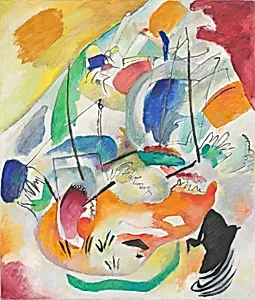
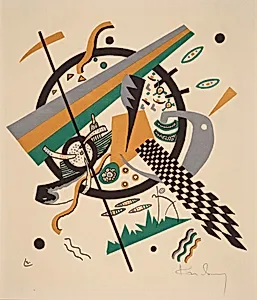
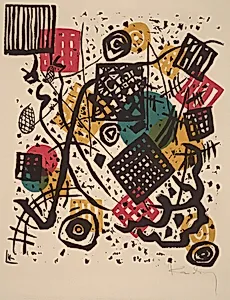
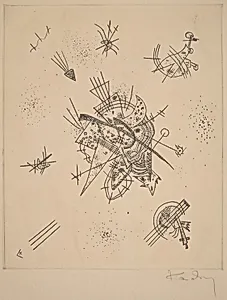
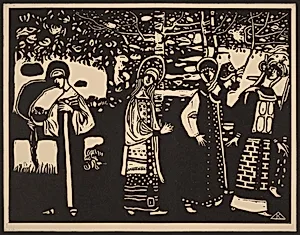
In Munich, Kandinsky studied at the Academy of Fine Arts under Franz von Stuck, co-founded the Phalanx art school, and in 1911 co-founded Der Blaue Reiter (The Blue Rider), one of the most important groups in the history of modern art, alongside Franz Marc, August Macke, and others. During this period, Kandinsky moved progressively from figurative painting through increasingly abstracted landscapes to fully non-representational compositions, producing his first abstract watercolor around 1910–13.
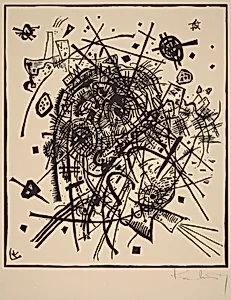
Kandinsky's theoretical writings — particularly "Concerning the Spiritual in Art" (1911) and "Point and Line to Plane" (1926) — articulated his belief that abstract forms and colors could directly communicate spiritual and emotional states, analogous to the way music communicates without representational content. These texts became foundational documents of abstract art theory.
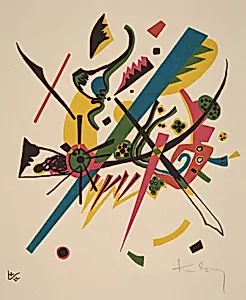
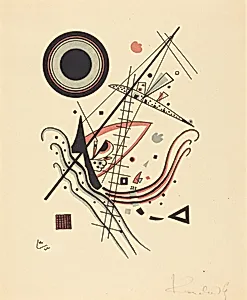
From 1922 to 1933, Kandinsky taught at the Bauhaus, where his work became more geometric and precisely structured, influenced by Constructivism and the Bauhaus environment. After the Nazis closed the Bauhaus, he moved to Paris, where he spent his final years producing works of increasingly biomorphic abstraction. His paintings are held by the Solomon R. Guggenheim Museum, the Centre Pompidou, the Städtische Galerie im Lenbachhaus in Munich, the Tretyakov Gallery in Moscow, and the Museum of Modern Art.