
Small Worlds III
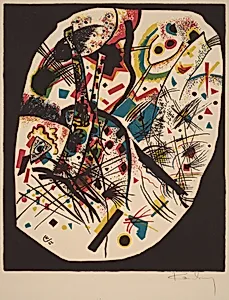
Medium
4-color lithograph
Classification
Department
CG-W
Museum
National Gallery of Art, Washington, D.C.
Credit
Print Purchase Fund (Rosenwald Collection)
Accession Number
1971.9.3
Rights
Public Domain
Art Historical Context
Wassily Kandinsky’s *Small Worlds III* (1922) captures the artist’s pioneering vision of abstraction during his influential years at the Bauhaus in Weimar. A Russian-born painter who helped shape modern art through his involvement with Der Blaue Reiter, Kandinsky turned to pure geometric forms and vibrant color relationships after World War I. Created as part of the *Small Worlds* print series, this 4-color lithograph distills cosmic and microscopic motifs into a compact, dynamic composition that invites viewers to explore an inner universe of circles, lines, and planes. The lithographic medium was especially suited to Kandinsky’s goals, allowing precise registration of overlapping hues and crisp edges while reaching a wider audience through printmaking. Each color layer builds rhythmic tension, reflecting his belief that color and form could evoke spiritual responses akin to music. Acquired through the Rosenwald Collection, the work now resides in the National Gallery of Art, where it exemplifies Kandinsky’s commitment to merging art, design, and pedagogy at a pivotal moment in twentieth-century modernism.
About the Artist
Wassily Kandinsky · 1866–1944
Wassily Kandinsky (1866–1944) was a Russian-born painter and art theorist who is widely credited as one of the pioneers of abstract art, producing some of the earliest non-representational paintings in Western art history. Born in Moscow, he initially studied law and economics at the University of Moscow before abandoning an academic career at thirty to study painting in Munich. In Munich, Kandin...