
Smallsword
Unknown Artist
ca. 1775–90
Medium
Bronze, gold, mother-of-pearl, steel, textile
Dimensions
L. 38 1/2 in. (97.8 cm); W. 4 in. (10.2 cm); D. 2 3/4 in. (7 cm); Wt. 13.2 oz. (374.2 g)
Classification
Swords
Culture
Western European
Department
Arms and Armor
Museum
Metropolitan Museum of Art, New York, NY
Credit
Gift of Jean Jacques Reubell, in memory of his mother, Julia C. Coster, and of his wife, Adeline E. Post, both of New York City, 1926
Accession Number
26.145.342
Rights
Public Domain
Art Historical Context
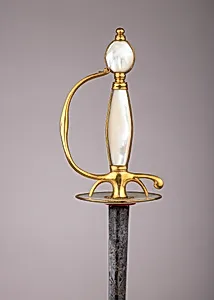
Step into the refined world of 18th Western Europe with this exquisite smallsword, crafted around 1775–90. Smallswords like this one marked the evolution of personal weaponry into symbols of gentility and status. No longer heavy battlefield arms, they were lightweight thrusting swords (just 13.2 oz. and 38½ inches long) favored by aristocrats for duels, self-defense, and as fashionable accessories worn with formal attire the Enlightenment era. The hilt showcases masterful artistry in bronze, gold, mother-of-pearl inlays, steel, and textile elements, blending functionality with opulence. These materials—gold for luster, iridescent mother-of-pearl for exotic allure—highlight advanced metalworking and decorative techniques, likely from a skilled European workshop. Such embellishments elevated the sword from mere tool to a wearable jewel, reflecting the owner's wealth and sophistication amid the cultural shifts of the late 1700s. Today, this gift to the Metropolitan Museum of Art honors New York patrons Jean Jacques Reubell’s mother and wife. It invites us to ponder how arms embodied both peril and prestige in an age of revolution and refinement.