
Snipe Decoy
1941
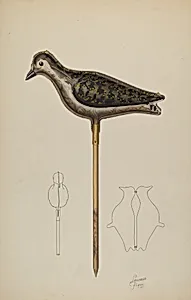
Medium
watercolor, graphite, and colored pencil on paperboard
Dimensions
overall: 53.6 x 34 cm (21 1/8 x 13 3/8 in.)
Classification
Index of American Design
Department
CG-W
Museum
National Gallery of Art, Washington, D.C.
Credit
Index of American Design
Accession Number
1943.8.9624
Rights
Public Domain
Art Historical Context
**Snipe Decoy** by Lawrence Flynn, created in 1941, is a meticulous rendering that captures the charm of American folk art. Measuring 53.6 x 34 cm, this work on paperboard employs watercolor, graphite, and colored pencil to vividly depict a carved wooden decoy used by hunters to lure snipe birds. Flynn's precise technique highlights the decoy's naturalistic form, feathers, and subtle coloration, blending fine art methods with documentary accuracy. As part of the *Index of American Design*—a Federal Art Project under the Works Progress Administration (1935–1942)—this piece preserves everyday objects that embody America's cultural heritage. The IAD commissioned artists like Flynn to document folk crafts, tools, and decorative arts threatened by time or modernization, creating a visual archive now housed in the National Gallery of Art. Snipe decoys, rooted in 19th- and early 20th-century hunting traditions, reflect regional ingenuity, often hand-carved by watermen in coastal areas. This artwork invites us to appreciate the artistry in utilitarian objects, bridging craft and culture. Its layered media evoke the decoy's tactile wood grain and lifelike allure, reminding visitors of how ordinary tools shaped American identity.
About the Artist
Lawrence Flynn · 1900–1973
Lawrence Flynn (1900–1973) was an American artist born in New Haven, Connecticut, where he attended the city's public schools. He pursued formal art training at the Art Students League in New York, studying anatomy under the renowned instructor George B. Bridgman, whose anatomical teachings profoundly influenced generations of artists. Flynn also honed his skills at the Yale School of Fine Arts, t...