
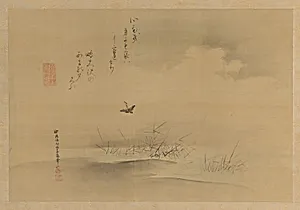
Snipe Over a Marsh from the <em>Three Dusks</em>
Classification
Painting
Department
Smithsonian Collection
Museum
Smithsonian American Art Museum
Credit
Gift of Charles Lang Freer
Accession Number
F1904.372
Rights
Public Domain
Tags
About this artwork
The "Three Dusks" or "Three Evening Poems" is a famous group of three poems by three different authors. The poems are recorded in the imperial poetry anthology Shin kokinshu, compiled in the early thirteenth century. The poem below, composed by the Buddhist monk Saigyo (1118-1190), is inscribed on this painting by Kano Tan'yu, one of the leading artists of the seventeenth century.
Art Historical Context
Kano Tan'yu’s *Snipe Over a Marsh* (1665) captures a quiet moment of natural observation while honoring Japan’s poetic tradition. Created during the Edo period by one of the era’s most influential painters, the hanging scroll (kakemono) belongs to a celebrated set inspired by three evening poems from the early-thirteenth-century anthology *Shin Kokinshū*. Tan’yu, a master of the Kano school and official painter to the Tokugawa shogunate, pairs delicate brushwork with the inscribed verse by the Buddhist monk Saigyō (1118–1190), allowing image and text to evoke the fleeting beauty of dusk. The composition reflects the refined taste of seventeenth-century Japanese literati culture, where painting and poetry were closely intertwined. Tan’yu’s restrained ink tones and subtle suggestion of marshland reeds invite viewers to linger on the solitary snipe in flight—an image that echoes Saigyō’s meditation on transience. As part of the Charles Lang Freer gift to the Smithsonian, the scroll continues to introduce Western audiences to the elegant interplay of word and image that defines classical Japanese aesthetics.