
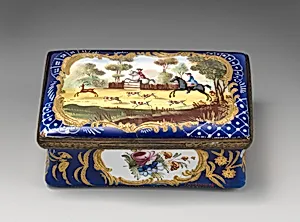
Snuffbox
Unknown Artist
ca. 1760–1800
Medium
Enameled copper
Dimensions
Overall: 1 1/2 × 3 1/2 × 2 1/8 in. (3.8 × 8.9 × 5.4 cm)
Classification
Enamels-Painted
Culture
British, Staffordshire
Department
European Sculpture and Decorative Arts
Museum
Metropolitan Museum of Art, New York, NY
Credit
Gift of J. Pierpont Morgan, 1917
Accession Number
17.190.1075
Rights
Public Domain
Tags
Art Historical Context
This exquisite snuffbox, crafted in Staffordshire, England, around 1760–1800, captures the elegance of Georgian-era decorative arts. During this period, finely made snuffboxes were essential accessories for gentlemen, used to carry powdered tobacco—a fashionable indulgence among the British elite. Produced in Staffordshire, a hub for innovative enameling workshops, this small treasure reflects the region's prowess in creating luxurious, portable objets d'art for everyday refinement. Fashioned from copper and adorned with painted enamels, the box measures just 1 1/2 × 3 1/2 × 2 1/8 inches, perfect for a waistcoat pocket. The vitreous enamel technique—fusing colorful glass-like paints onto metal through multiple firings—produced vibrant, durable scenes of a spirited hunt: deer fleeing through wooded landscapes dotted with flowers, pursued by dogs and horses. These motifs celebrated Britain's aristocratic passion for foxhunting and the countryside, blending pastoral beauty with dynamic action. A generous gift to the Metropolitan Museum of Art from J. Pierpont Morgan in 1917, this anonymous artwork exemplifies the artistry of "painted enamels," a classification prized for its jewel-like quality and narrative charm. Step closer and admire how it turns a utilitarian object into a miniature masterpiece!