
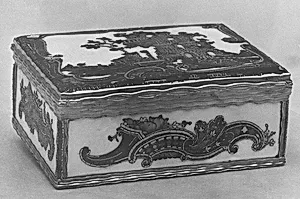
Snuffbox
Medium
Hard-paste porcelain, gold, lacquer, mother-of-pearl, stone
Dimensions
1 3/16 x 2 3/16 x 2 13/16 in. (3 x 5.6 x 7.1cm)
Classification
Ceramics-Porcelain
Culture
German, Meissen
Department
European Sculpture and Decorative Arts
Museum
Metropolitan Museum of Art, New York, NY
Credit
Gift of R. Thornton Wilson, in memory of Florence Ellsworth Wilson, 1955
Accession Number
55.216.3
Rights
Public Domain
Tags
Art Historical Context
This delicate snuffbox, crafted around 1750 by the renowned Meissen Manufactory and by Johann Martin Heinrici exemplifies the pinnacle of 18th-century European porcelain artistry. Measuring just 1 3/16 x 2 3/16 x 2 13/16 inches, it was designed as a luxury accessory for gentlemen to carry finely ground tobacco snuff—a fashionable indulgence among the elite during the Rococo period. Vibrant fruit motifs, likely rendered in Heinrici's skilled hand, adorn its surface, capturing the era's delight in naturalistic abundance and playful opulence. Meissen, founded in 1710 near Dresden, Germany, revolutionized the decorative arts by perfecting hard-paste porcelain, a durable, translucent material previously monopolized by Chinese exports. This breakthrough allowed Europeans to produce wares of unmatched quality, fueling a craze for porcelain objects that symbolized wealth and sophistication. Snuffboxes like this one were prized conversation pieces, blending functionality with exquisite decoration. The box's hard-paste porcelain body is lavishly enhanced with gold, lacquer, mother-of-pearl, and stone inlays, showcasing advanced gilding and overglaze enamel techniques. Now housed in The Metropolitan Museum of Art's European Sculpture and Decorative Arts collection, it highlights Meissen's enduring legacy in ceramics, where technical innovation met artistic whimsy.
About the Artist
Johann Martin Heinrici|Meissen Manufactory · 1711–1786
**Johann Martin Heinrici (1711–1786)** was a German porcelain painter, miniaturist, and engraver renowned for his exquisite decorative work on luxury objects and porcelain during the mid-eighteenth century. Born in Lindau in 1711, he became one of the leading figures in the specialized field of porcelain decoration and lacquerwork techniques adapted for European tastes. Heinrici trained and worke...