
Snuffbox
ca. 1760
Medium
Hard-paste porcelain, gold, silver, diamonds, rubies
Dimensions
2 1/8 × 3 1/8 in. (5.4 × 7.9 cm)
Classification
Ceramics-Porcelain
Culture
German, Meissen
Department
European Sculpture and Decorative Arts
Museum
Metropolitan Museum of Art, New York, NY
Credit
Gift of Mr. and Mrs. Charles Wrightsman, 1977
Accession Number
1977.1.10
Rights
Public Domain
Tags
Art Historical Context
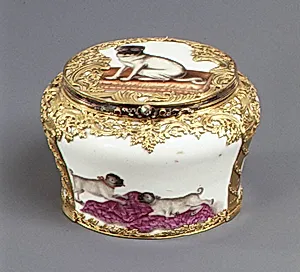
This delicate snuffbox, crafted by the renowned Meissen Manufactory around 1760, exemplifies pinnacle of 18th European luxury. Made of hard-paste porcelain—a breakthrough invention by Meissen in1710 that mimicked prized Chinese material with its translucency and durability—the box is adorned with lavish gold and silver mounts, sparkling diamonds, and rubies Measuring just 2 1/8 × 3 1/8 inches, its petite scale belies its opulence, featuring finely painted or modeled dogs, a motif beloved by the aristocracy for evoking hunting scenes and loyal companions. Meissen porcelain revolutionized decorative arts, transitioning from secretive royal patronage under Augustus the Strong to widespread elite connoisseurship by the Rococo era. Artisans employed meticulous techniques like overglaze enameling and gilding to achieve vibrant details on the porcelain surface, while the jewel-encrusted fittings elevated it to a status symbol for snuff-taking, a fashionable vice among Europe's nobility. Dogs on such pieces often symbolized fidelity and leisure pursuits, blending whimsy with technical virtuosity. A generous gift to The Metropolitan Museum of Art from Mr. and Mrs. Charles Wrightsman in 1977, this snuffbox captures the cultural splendor of German porcelain mastery, inviting us to marvel at the fusion of artistry and extravagance in everyday indulgences of the Enlightenment age.
About the Artist
Meissen Manufactory · 1710–present
The Meissen Manufactory, established on June 6, 1710, by Augustus the Strong, Elector of Saxony and King of Poland, marked the dawn of true hard-paste porcelain production in Europe. Nestled at Albrechtsburg Castle in Meissen near Dresden, the Royal Polish and Electoral Saxon Porcelain Manufactory arose from alchemical experiments begun in 1708 by physicist Ehrenfried Walther von Tschirnhaus and p...