
Snuffbox
Unknown Artist
ca. 1760
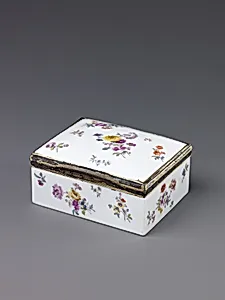
Medium
Hard-paste porcelain, silver-gilt mounts.
Dimensions
H. 4.3 cm, L. 8.4 cm, D. 6.7 cm
Classification
Snuffboxes
Culture
German, Meissen
Department
Robert Lehman Collection
Museum
Metropolitan Museum of Art, New York, NY
Credit
Robert Lehman Collection, 1975
Accession Number
1975.1.1546
Rights
Public Domain
Tags
Art Historical Context
This exquisite snuffbox, crafted around 1760 by an unknown artist at the renowned Meissen porcelain factory in Germany, exemplifies the pinnacle of 18th-century European luxury. Made from hard-paste porcelain—a groundbreaking material developed by Meissen in 1710, the first in Europe to replicate the translucent quality of Chinese porcelain—the features intricate floral decorations, a hallmark of Meissen's rococo style. Adorned with gleaming silver-gilt mounts, measures a compact 4.3 cm high, 8.4 cm long, and 6.7 cm deep, for discreetly carrying powdered tobacco. Snuffboxes like this were status symbols among the European aristocracy during the Rococo era, blending functionality with opulent artistry. Meissen's mastery of painting delicate flowers directly onto the fired porcelain surface showcased advanced techniques in overglaze enameling, ensuring vibrant, durable colors. This piece, part of the Robert Lehman Collection at The Metropolitan Museum of Art, highlights the cultural vogue for snuff-taking, a refined social ritual that spread from France across courts, underscoring porcelain's role in elevating everyday indulgences to fine art. Today, it invites us to appreciate how Meissen's innovations democratized luxury, influencing global ceramics while capturing the playful elegance of floral motifs in an age of enlightenment and excess.